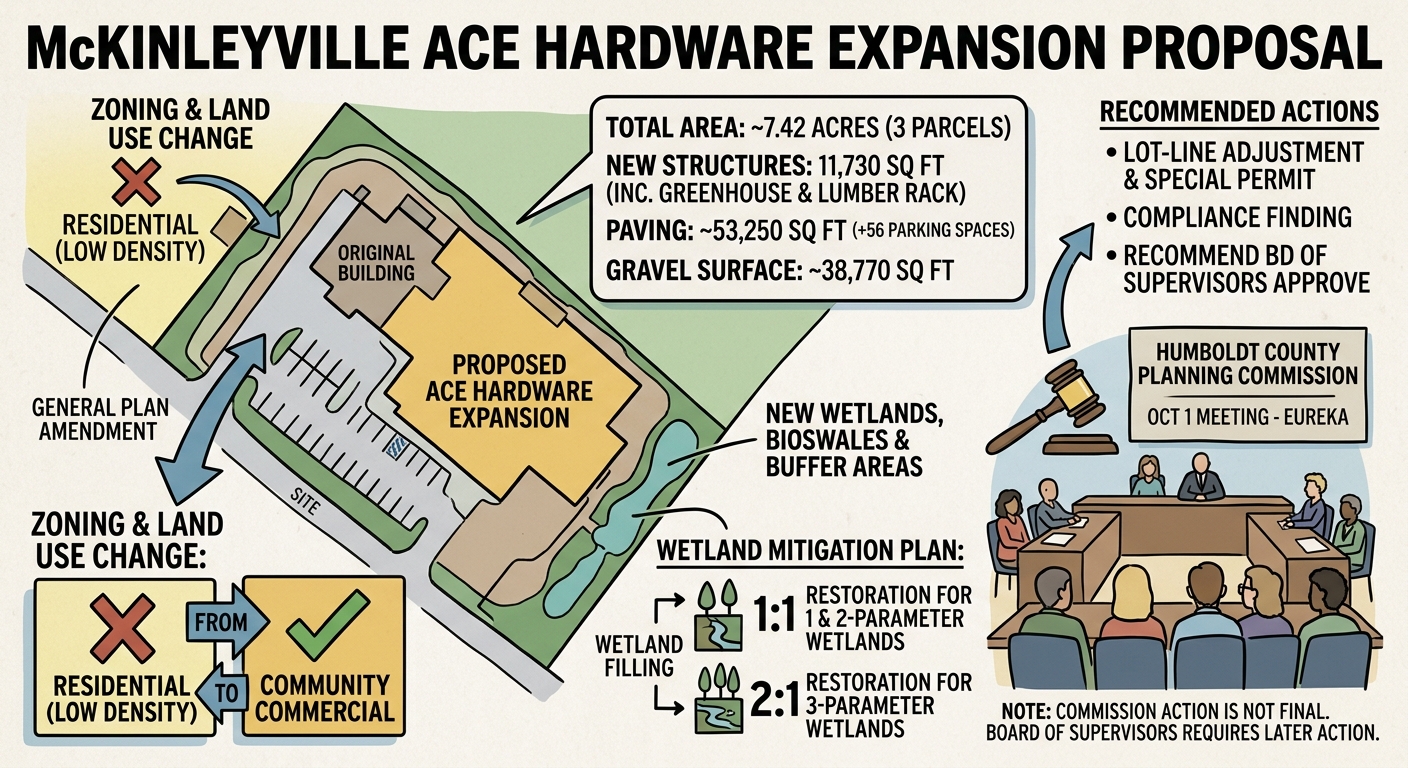
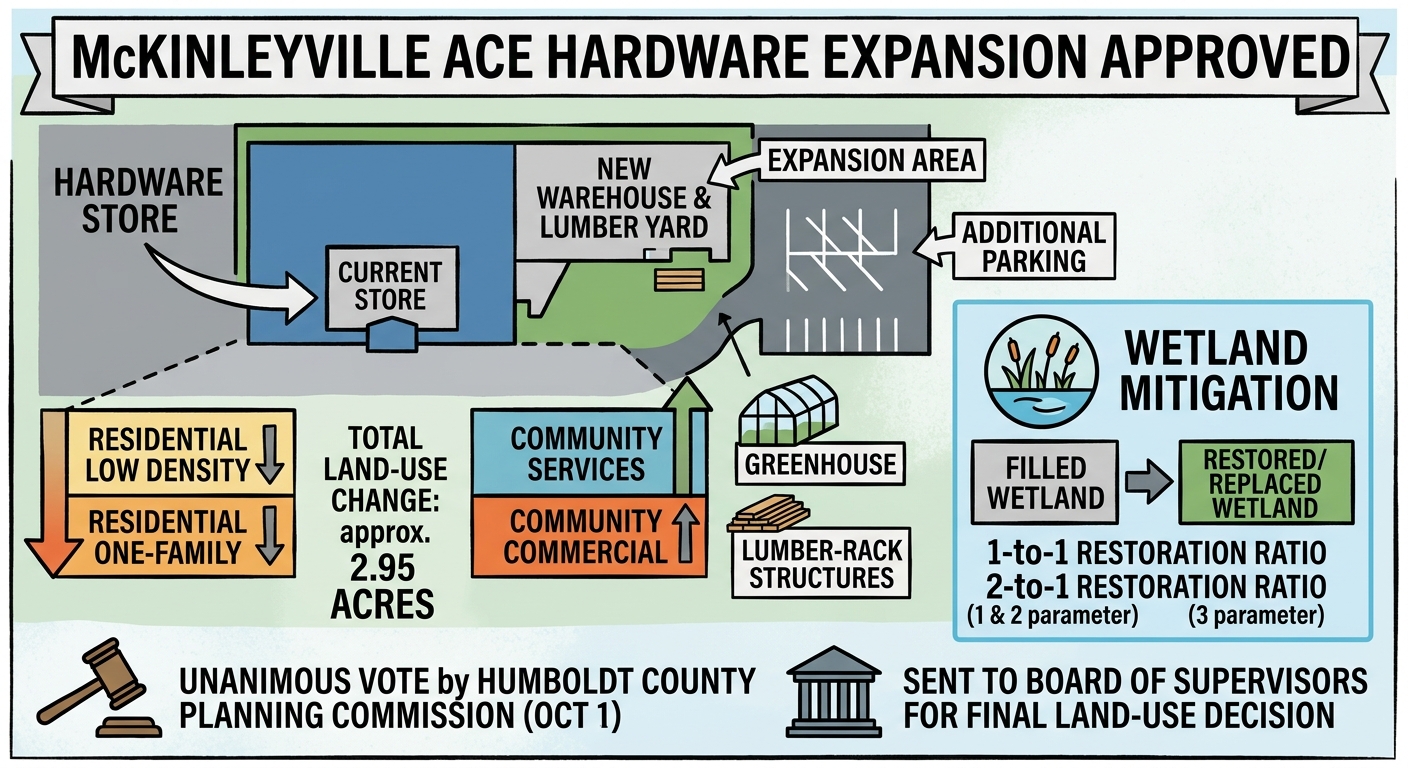
The Humboldt County Planning Commission unanimously approved a package of permits and environmental documents for a proposed expansion of McKinleyville Ace Hardware, while sending related land-use changes to the Board of Supervisors for a final decision.
The commission’s six participating members voted yes on Oct. 1 for Black Dog Partnership LP’s lot-line adjustment and wetland special permit, along with the project’s mitigated negative declaration and mitigation monitoring program. Commissioners also found the project consistent with the county’s General Plan and zoning, according to the recorded meeting.
The project, identified in the county’s Oct. 1 agenda as record PLN-2021-17029, would shift the boundaries of land-use and zoning designations across about 2.95 acres. The proposal includes about 53,250 square feet of additional paving for an estimated 56 parking spaces, about 38,770 square feet of gravel surface and three structures totaling 11,730 square feet, including a greenhouse and lumber-rack structures.
The plan also calls for reconfiguring access and restoring, consolidating or relocating wetlands. County staff said the environmental measures include stormwater treatment before discharge to wetlands, wetland buffers, construction monitoring and restoration requirements. The project’s proposed mitigation includes restoration at a 1-to-1 ratio for filled one- and two-parameter wetlands and a 2-to-1 ratio for filled three-parameter wetlands.
The commission recommended that supervisors approve a General Plan Amendment and zone reclassification for portions of three McKinleyville parcels, increasing the Community Services and Community Commercial designations while reducing the Residential Low Density and Residential One-Family designations by the same area. That recommendation does not complete the project’s land-use approvals. The supervisors’ hearing date and final vote were not identified in the available record.
A final Planning Commission resolution and signed mitigation documents were also not located in the available record. Those documents could show whether the approved conditions differ from the draft materials presented to commissioners.