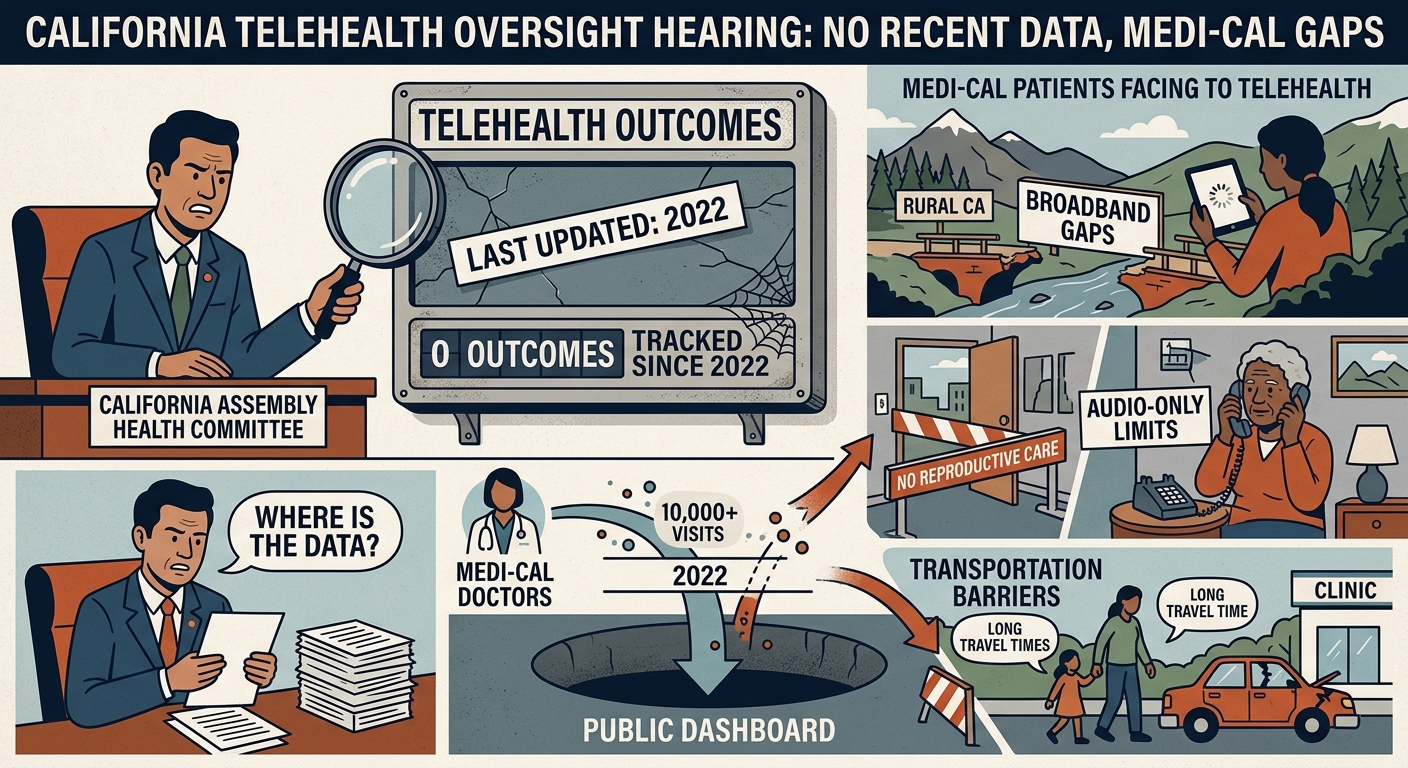
California lawmakers reviewing the state’s telehealth laws on Aug. 4 said a public dashboard meant to track outcomes has not been updated since 2022, leaving them without current statewide data as they weigh the next steps for Medi-Cal coverage.
At an Assembly Health Committee outcomes review hearing, Chair Bonta said the panel was examining AB 744 and AB 32 to see what is working and what gaps remain. Marissa Montano, a senior policy officer with the California Healthcare Foundation, told lawmakers that the publicly available telehealth dashboard created during the pandemic “hasn’t been updated since 2022,” even though billing data continues to be collected.
Amy Durbin of the Center for Connected Health Policy said California’s Medi-Cal program still has limits around asynchronous or store-and-forward telehealth, including some e-visits, interprofessional consultations and e-consults, and that federally qualified health centers and rural health centers face additional billing restrictions. She said those gaps remain despite the broader expansion of telehealth coverage in the state.
Lawmakers and witnesses also described telehealth as an important tool for rural residents, older adults, working families and patients with transportation, broadband or language barriers. Dr. Stefan Newman, a family physician, said virtual visits are now part of his regular practice and can speed care when an appointment needs to turn into an office visit or emergency referral. Angela Pontus, speaking for Planned Parenthood Affiliates of California, said audio-only and asynchronous telehealth are especially important for sexual and reproductive health care, but current Medi-Cal policy still limits some of those services for new patients.
Jamie Gray, a licensed clinical social worker at Chester Community Health Center, said telehealth has been especially valuable for rural behavioral health patients in Shasta County, where travel and broadband access can be major obstacles. Several speakers said telehealth should remain an option alongside in-person care, not a replacement for it.
The hearing did not appear to produce a policy decision, but it surfaced a concrete oversight issue: lawmakers are debating telehealth policy without a current public dashboard showing how the system is performing.