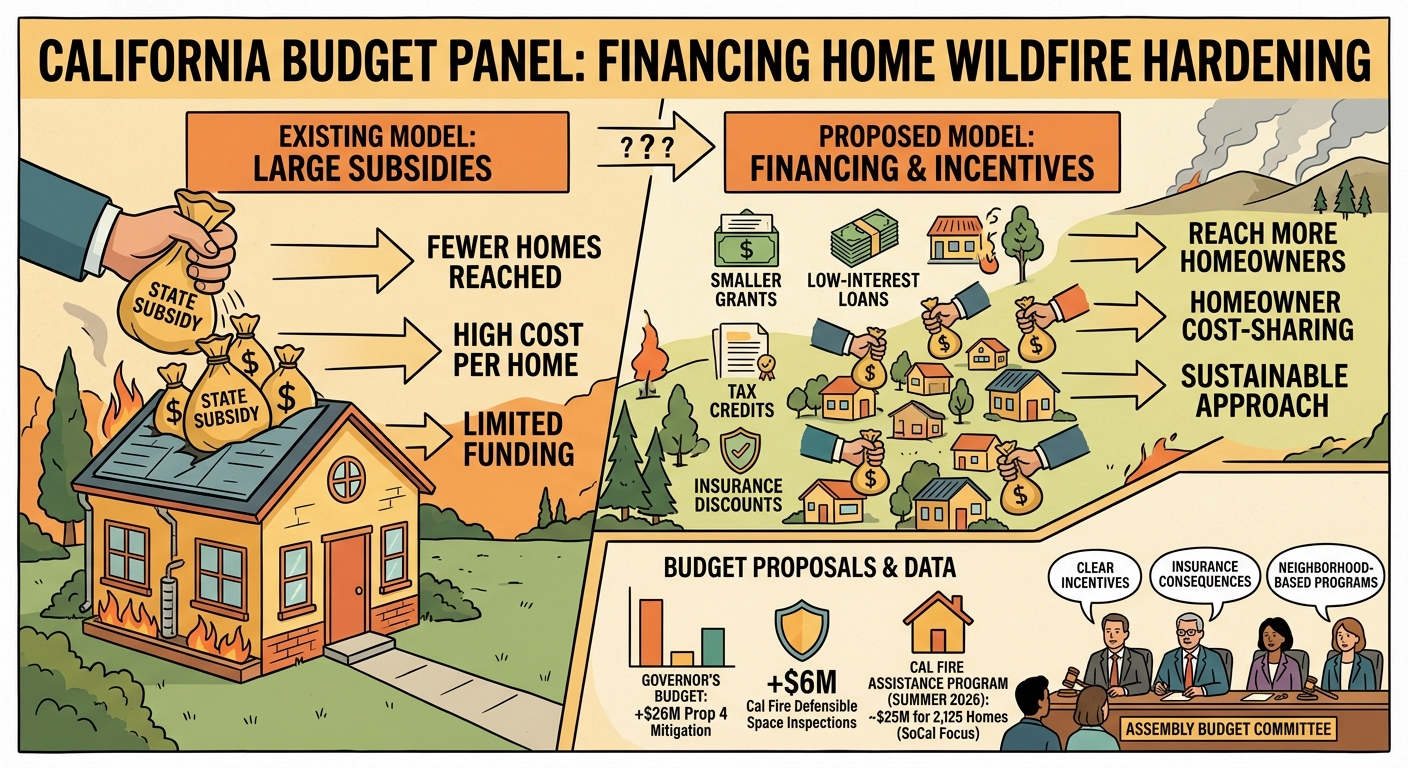
Assembly budget lawmakers on May 6 heard competing ideas for how California should scale wildfire home hardening, with witnesses and members debating whether the state should continue relying on large subsidies or move toward a financing-and-incentives model built around smaller grants, loans and insurance discounts.
The hearing did not end with a vote or formal recommendation, but it did surface several budget proposals for 2026-27. According to the Legislative Analyst’s Office summary presented at the hearing, the governor’s budget would add $26 million in Proposition 4 funding for the California Wildfire Mitigation Program and $6 million in ongoing General Fund support for Cal Fire defensible-space inspections.
Cal Fire also told lawmakers that a defensible-space financial assistance program is expected to launch in summer 2026 with about $25 million available, enough to help roughly 2,125 homes, according to the hearing materials. The program was described as focused in Southern California.
Beyond the funding details, witnesses argued over the best way to reach far more homeowners. Eric Horn of Megafire Action said California should not try to pay for every retrofit, and instead should use low-interest loans, small grants, tax credits and insurance discounts to lower the cost of adoption. Other local fire-prevention leaders described neighborhood-based programs that pair assessments, grants and outreach with homeowner cost-sharing.
State fire officials said defensible-space staffing and zone-zero implementation need permanent support, while lawmakers pressed for clearer incentives and stronger insurance consequences for mitigation work. The hearing record provided for the story does not show a committee vote or a final budget action, but it does suggest wildfire mitigation funding and financing will remain part of the next round of budget negotiations.