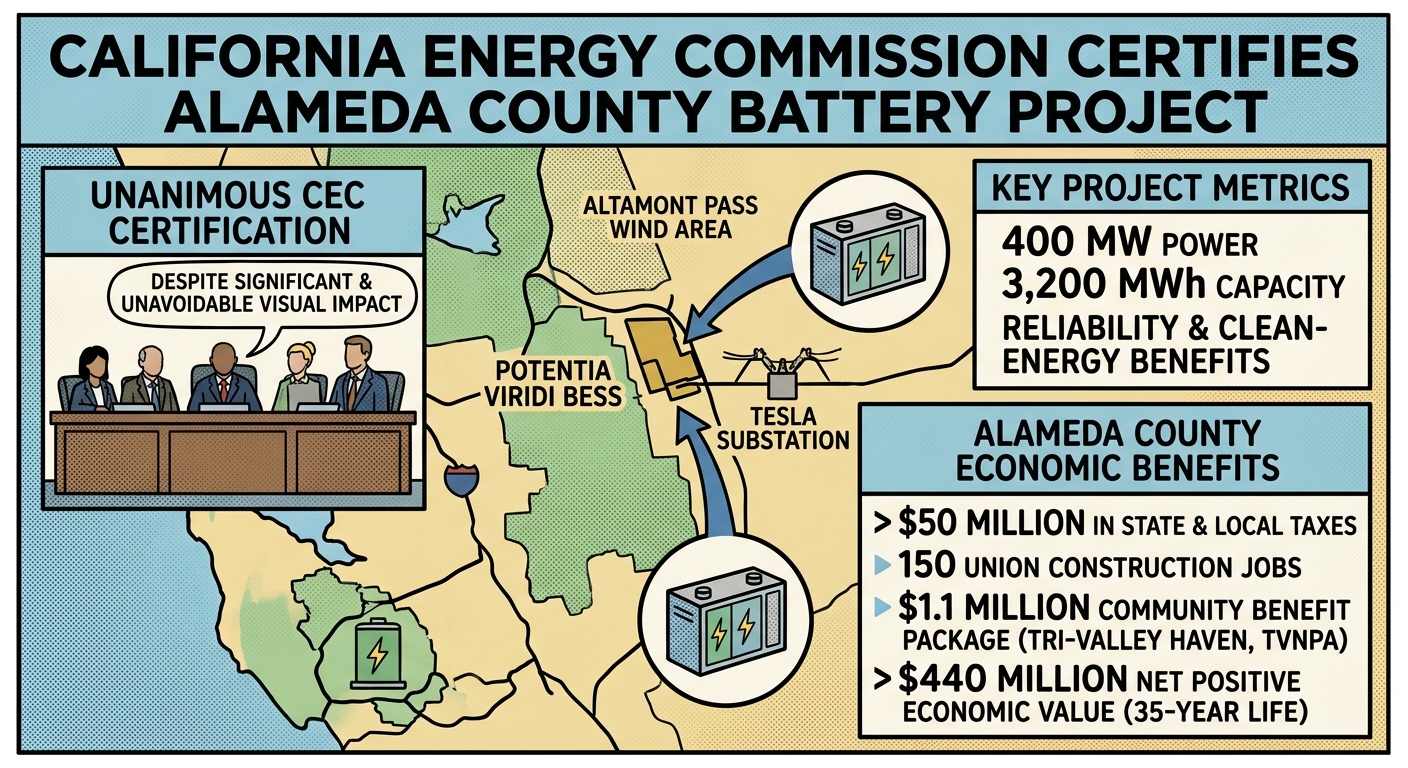
The California Energy Commission unanimously certified the Potentia Viridi Battery Energy Storage System in Alameda County on Monday, advancing a 400-megawatt, 3,200-megawatt-hour project under the state’s opt-in permitting program despite a finding of one significant and unavoidable visual impact.
Staff told commissioners that the project’s impacts could be reduced below significance in all other CEQA categories through conditions of certification, but that visual resources remained a significant and unavoidable issue. Staff nevertheless said the record supported a statement of overriding considerations and certification of the project. Commissioners approved the project unanimously after weighing those findings against what they described as reliability and clean-energy benefits.
At the meeting, project presenter Eric Vierkamp described the proposal as an opt-in battery storage project in Alameda County tied to a site near existing energy infrastructure, including the Altamont Pass wind energy area and the Tesla substation. Clearway Energy Group representative Julia Zuckerman said the project would improve grid reliability, support California’s clean-energy goals, and bring more than $50 million in state and local taxes over its operating life.
Zuckerman also said the project would create about 150 union construction jobs and include a $1.1 million community benefit package. That package includes two community benefits agreements totaling $925,000 with Tri-Valley Haven and the Tri-Valley Nonprofit Alliance, plus $200,000 for future donations through Clearway’s community engagement program.
Public commenters and stakeholders spoke in favor of the project, including representatives of the State Building and Construction Trades Council of California, the Office of Alameda County Supervisor David Halbert, Tri-Valley Haven, the Tri-Valley Nonprofit Alliance, and Lucas Griffith of McQuinney Ranch Properties, whose family owns the land associated with the project site. Commissioner Gallardo said the project also would provide more than $440 million in net positive economic value to Alameda County over its estimated 35-year life.
The commission’s approval came after staff said Alameda County does not yet have an ordinance governing siting of energy storage projects, which is why the project came to the commission through the opt-in program.