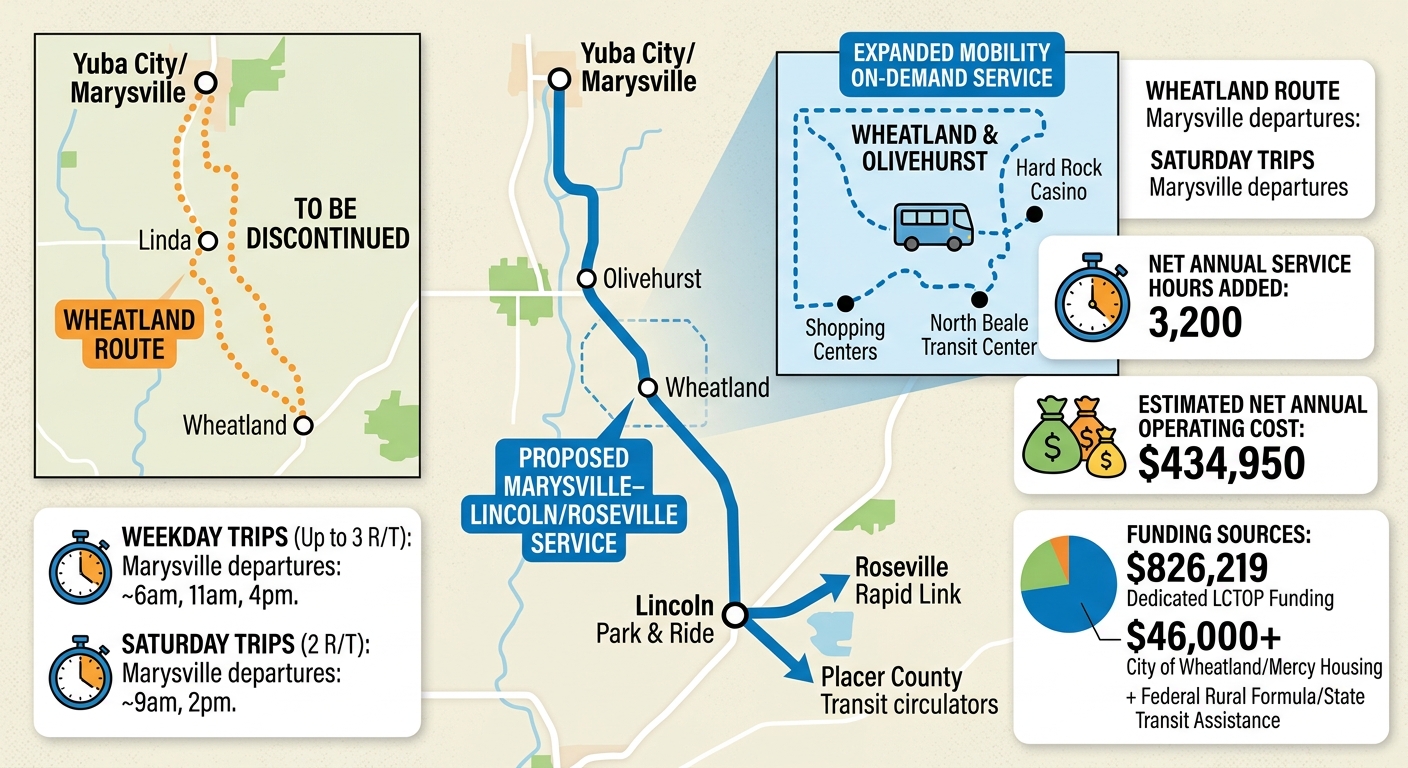
Yuba-Sutter Transit directors were scheduled Sept. 17 to hold a public hearing and consider approval of a proposed Marysville–Lincoln/Roseville service that would replace the existing Wheatland Route, according to the agency’s meeting agenda and staff report.
The proposed service would run Monday through Saturday along the State Route 65 corridor, with stops in Olivehurst and Wheatland and a southern terminus at Lincoln Park & Ride. The plan is intended to connect with Placer County Transit circulators and Roseville’s Rapid Link service. The agenda describes up to three weekday round trips, with proposed Marysville departures at about 6 a.m., 11 a.m. and 4 p.m., and two Saturday round trips departing at about 9 a.m. and 2 p.m. The final route and schedule were still being developed and tested.
The proposal also calls for expanded Mobility On-Demand service within Wheatland and Olivehurst. Staff said the service would operate in Wheatland from approximately 8:30 a.m. to 4:30 p.m. on weekdays and from 10:30 a.m. to 1:30 p.m. Saturdays, allowing riders to travel within Wheatland and Olivehurst or connect with the fixed route. Planned destinations include the Hard Rock Hotel and Casino, shopping centers and public services near the North Beale Transit Center in Linda.
If approved, the existing Wheatland Route would be discontinued when the new service launches. Staff proposed a soft launch on or after Oct. 12, 2026, followed by broader promotion after testing the regional connections.
The service plan would add an estimated 3,200 net annual service hours and cost about $434,950 in net annual operating expenses, after estimated fare revenue and the reduction from ending the existing Wheatland Route. Yuba-Sutter Transit said it has been awarded $826,219 in dedicated Low Carbon Transit Operations Program funding for the proposed service. Staff also said an updated partnership agreement with the city of Wheatland and Mercy Housing, if approved, would provide at least $46,000 annually, adjusted for inflation, for at least the first three years. Federal rural formula funding or state transit assistance would cover remaining costs, according to the staff report.
The agenda record shows the board was being asked to conduct the hearing and approve the plan and fare structure “as proposed or amended.” It does not establish whether directors approved the proposal, the final schedule or a launch date.