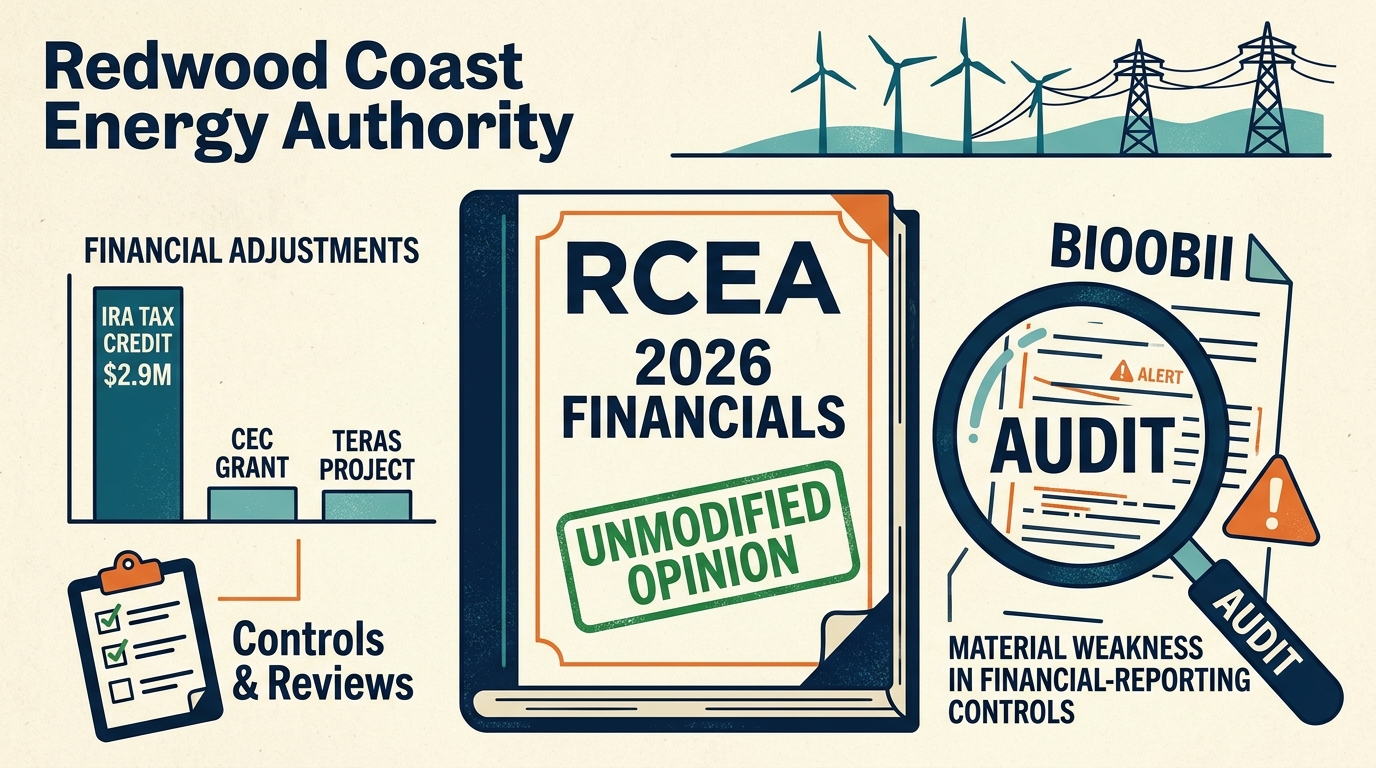
The Redwood Coast Energy Authority received an unmodified opinion on its fiscal 2026 financial statements from independent auditor Baker Tilly, which also identified a material weakness in the authority’s financial-reporting controls.
The finding involved RCEA’s process for closing its books, preparing financial statements and footnotes in accordance with generally accepted accounting principles, recording auditor-recommended adjusting entries and independently reviewing the reports, according to the RCEA Board packet for its Oct. 22, 2026, meeting.
Baker Tilly defines a material weakness as a deficiency, or combination of deficiencies, creating a reasonable possibility that a material misstatement will not be prevented or detected and corrected in time. The audit communication said management had not prepared financial statements conforming to GAAP and that the auditors recommended material adjusting journal entries.
One entry recognized $2,930,582 in Inflation Reduction Act tax-credit revenue and a matching accounts-receivable balance, according to the board packet. The packet’s audit materials also list other adjusting entries, including entries involving a California Energy Commission electric-vehicle grant and a payment connected to the TERAS project.
The audit communication said Baker Tilly did not identify any known or suspected fraud or any noncompliance with laws and regulations during the audit. The control finding therefore concerns the reliability and review of the financial-reporting process, not an allegation of fraud.
The materials reviewed for this report do not identify a completed remediation plan, a deadline for correcting the weakness or officials assigned to oversee that work. They also do not establish how the board responded to or voted on the audit. RCEA’s follow-up plan and any board action were not included in the packet.