The California Energy Commission on Oct. 19 approved a $3,483,212 EPIC grant to the University of California, Riverside, for a virtual-power-plant demonstration on PG&E substations and feeders serving disadvantaged communities. The commission approved the two grants under its Coordinated Holistic Orchestration of Inverter-Based Resources, or CHIRE, solicitation by a 3-0 vote, according to the CEC business-meeting record.
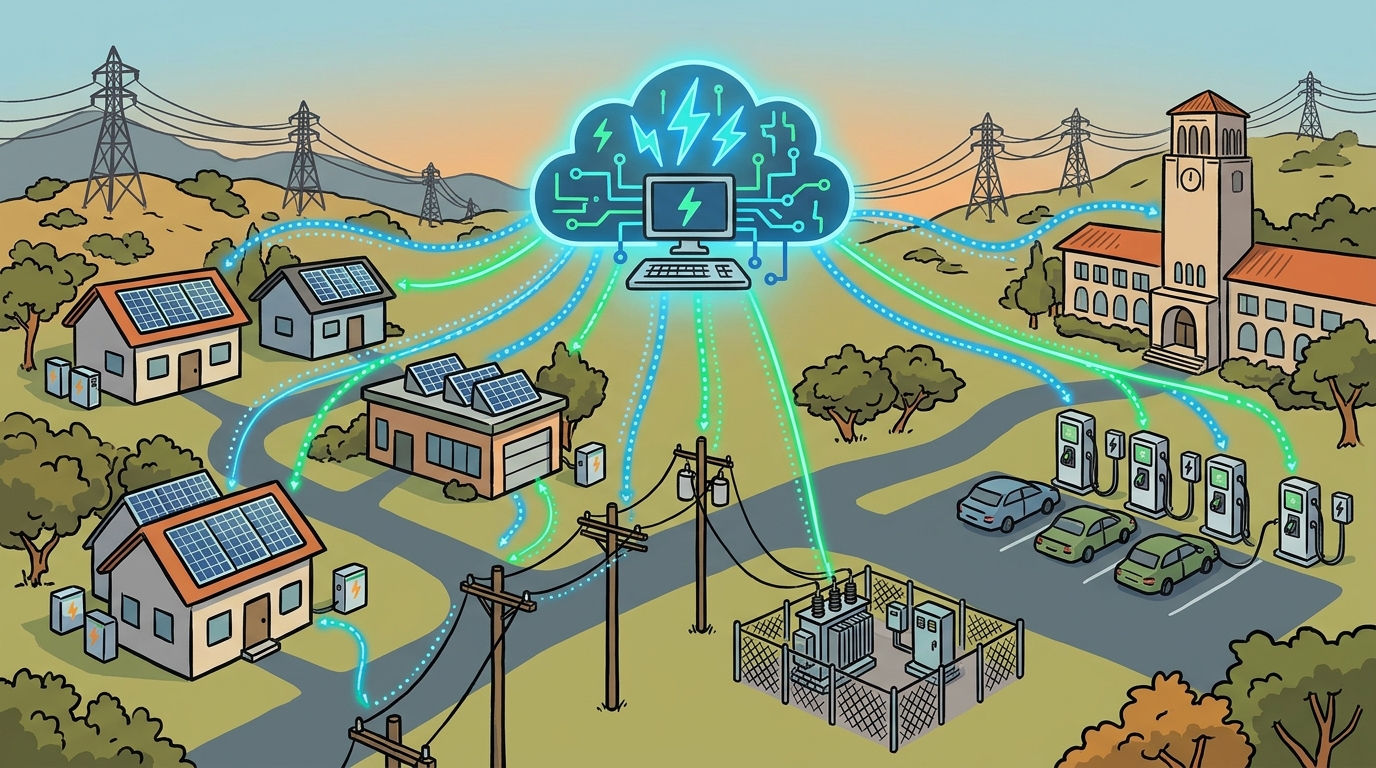
The project, called “Coordinated VPP for Distribution-Level Services,” would run from Nov. 2, 2026, through Nov. 1, 2030. The grant packet says it will coordinate battery-storage systems, electric-vehicle charging equipment and photovoltaic systems across multiple PG&E substations and feeders. The packet does not identify the specific feeder or substation locations.
The project is intended to test whether customer-sited energy resources can provide services on the distribution grid under utility operating conditions, rather than primarily participating in wholesale markets. Planned services include localized congestion mitigation, reactive-power and voltage support, power-quality improvements and coordinated EV charging intended to help avoid feeder- and substation-level constraints.
The work plan includes grid simulations, baseline assessments, customer and site-readiness work, community outreach and deployment of the virtual power plant. It calls for a full-year field demonstration followed by independent measurement and verification, as well as an evaluation of project benefits and potential frameworks for valuing and compensating distribution-level services.
PG&E is listed as an unfunded utility partner responsible for demonstration-level integration and message exchange. Olivine Inc. is identified as the VPP technology provider, with Qualus LLC, GRID Alternatives and Agmonitor Inc. also listed as subcontractors. The CEC packet says the project will prioritize participation and outreach in disadvantaged communities.
The grant packet describes potential benefits including improved reliability and power quality, possible deferral of traditional grid upgrades, safety improvements and reduced reliance on emergency generation. It does not provide customer-enrollment targets or detail PG&E’s operational commitments, leaving those issues for later project filings and reporting.